


06/07/2021
Bogotá, 6 July 2021.
The initiative was supported by 105 organizations from 48 municipalities located in the departments of Antioquia, Atlántico, Bogotá, Bolívar, Boyacá, Caldas, Caquetá, Casanare, Cauca, Cundinamarca, Huila, Meta, Nariño, Quindío, Cesar, Risaralda, Santander and Tolima.
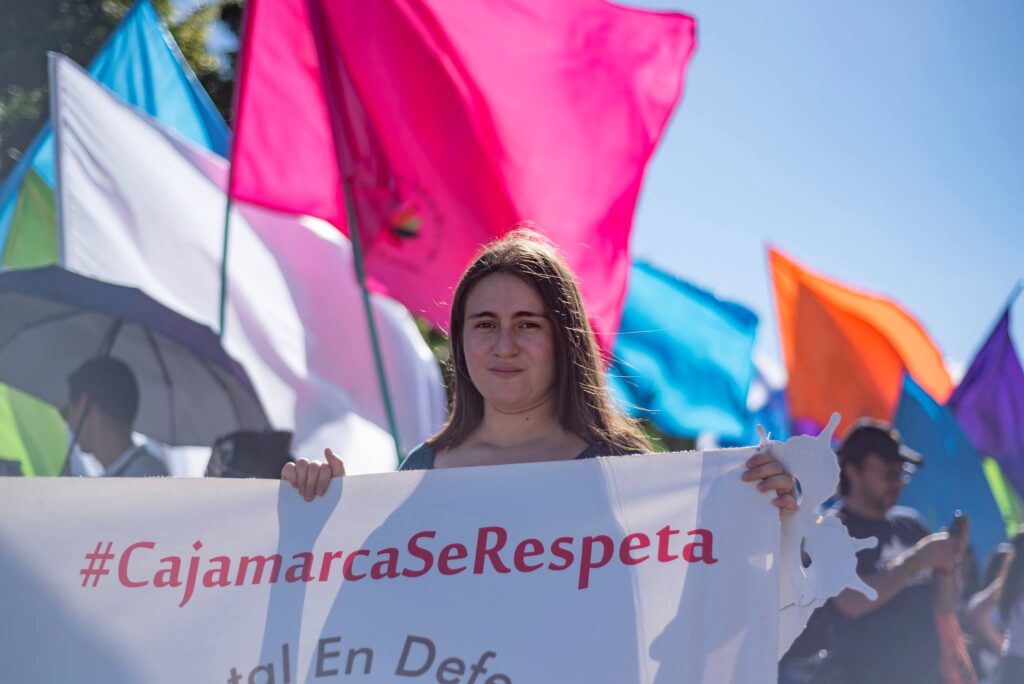
Social organizations that are members of the National Environmental Movement announced that they presented a Statutory Draft Bill to the Congress of the Republic. This, with the aim of regulating the right to citizen participation in exploration and exploitation of non-renewable natural resources projects.
“On July 20 a new legislature begins and with this proposal we seek to establish clear mechanisms to ensure that communities that may be affected by mining and hydrocarbon projects actively participate in decision-making regarding their territory”, said Robinson Mejia, a member of the National Environmental Movement.
It is important to mention that the proposal was already received by Congressmen Antonio Sanguino, Iván Cepeda, Inti Asprilla, Angélica Lozano, Jorge Eduardo Londoño and María José Pizarro, and will be filed at the beginning of the legislature of the Congress of the Republic in the next few days.
This initiative arises after, in 2018 and through judgment SU-095, the Constitutional Court ordered the Congress to issue a law that guarantees participation mechanisms for citizens to express themselves in front of mining and hydrocarbon projects.
That order has as origin the finding made by the Court, based on the case analyzed in that judgment, of the lack of specific mechanisms to guarantee the right to citizen participation in mining and hydrocarbon legislation. In the words of the Court, the fact that the laws regulating these industries do not guarantee this right constitutes a “constitutionally inadmissible deficit”.
However, although the order of the Court was given in 2018, today, three years later, the Congress has not yet discussed a legislative proposal that points in this direction, as other proposals that have not had a focus on citizen participation have been debated, so the Congress remains indebted to the citizenry.
“On the basis of the judgment of the Court, what we are seeking with this initiative is to guarantee a rights approach that mining and hydrocarbon legislation has never had and to guarantee the extension of the democratic principle to aspects as relevant to social life as the implementation of exploration and exploitation of non-renewable natural resources projects”, explained Viviana Tacha, SIEMBRA lawyer, Sociolegal Center for the Defense of the Territory.
The proposals of the draft bill to guarantee this participation take up already existing mechanisms such as open lobbying and public hearings but adapted to the socio-environmental needs of the territories. Thus, the project develops a socio-environmental open lobby and a public hearing of socio-environmental control to ensure the participation of citizens in different phases of these projects, taking into account whether we are dealing with new projects and projects in the exploration, exploitation or closure phase
The design of these participatory mechanisms also has a common basis, consisting of a broad and complex understanding of the territory. In this way, decision-making will not only be oriented, as is currently the case, by the energy mining potential of the territories but by other environmental, economic, social and cultural factors relevant to community life.
This Draft Bill also establishes the right of priority in the realization of the socio-environmental open lobby for municipalities that have already carried out popular consultations on extractive projects, as well as for those who have adopted municipal agreements on this subject. In this way, an explicit recognition is made of the legitimacy and validity of these citizenship exercises, which met all the legal requirements and through which the people expressed their will. With this proposal, the organizations seek to prevent the emergence of new socio-environmental conflicts and solve those that are in force, caused by the imposition of mining and oil projects, as well as deepening the model of participatory democracy that characterizes the 1991 Political Constitution.



 Contact Us
